Before students even arrive on campus, the European Civilization Chair offers them an historical foundation through the pre-recorded introductory course taught by Professor Richard BUTTERWICK-PAWLIKOWSKI on the “History of European Civilization”. This concentrates on cultural and societal transformations, crises, and breakthroughs from the Renaissance and Reformations to the apparent zenith of European hard and soft power before the First World War.
At the start of the first semester the Chair historically and regionally grounds Natolinians' studies through the compulsory courses taught successively by Professor Richard BUTTERWICK-PAWLIKOWSKI on the “History of Central and Eastern Europe, 1740-1940” and Professor Georges MINK on “L’Europe centrale et orientale depuis 1940”. The former covers the changes that began with the struggles for primacy in the region between Russia, Austria, and Prussia, and the consequent destruction of the Polish-Lithuanian Commonwealth, and ended with a new partition of Poland and the Baltic states between the Soviet Union and Nazi Germany in 1939-40. The latter explores the political, social and cultural transformations of the Central and East European region since the outbreak of the Second World War, including the period of Soviet domination, the process of desovietization and the construction of political democracy and a liberal economy.
Students can follow up these courses by participating in one of two simulation games led by the Chair’s professors: either “The Paris Peace Conference of 1919-1920”, led by Professor BUTTERWICK-PAWLIKOWSKI, or “Drafting a Peace Treaty for the End of the Cold War”, led by Professor MINK and Professor Marek CICHOCKI. They may also choose a Masterclass with Professor CICHOCKI and Dr Sławomir DĘBSKI on “Cold War Strategies from the Central Eastern Europe Perspective”.
The European Civilization Chair is at the heart of the second semester major "European History and Civilization”, whose courses are available to all students. Among these courses are the simulation game “The Congress of Vienna, 1814-1815” and three specialist courses taught by Professor CICHOCKI on the “From the Greek Agora to the Ukrainian Euromaidan: the History of Ideas of Democracy in Europe”. Dr Sławomir DĘBSKI on the “Between a Rock and a Hard Place: Central European Strategic Thought And Practice”, and Professor MINK on the "Histoire, mémoire, usages et mésusages politiques, de la Seconde Guerre mondiale à Poutine".
Among the visiting professors are some of the world’s leading historians. Assessed core courses and specialist courses are complemented by compact seminars and workshops. The latter, led by postdoctoral fellows of the Max Weber Programme at the European University Institute in Florence, change each year.
All students writing a Master's thesis on a history-related subject can benefit from the workshop run by the Tutorial Fellow, Dr Jason ROZUMALSKI in historical research and writing. Students can also present their thesis at the Chair's research seminar, and obtain feedback from the resident professors.
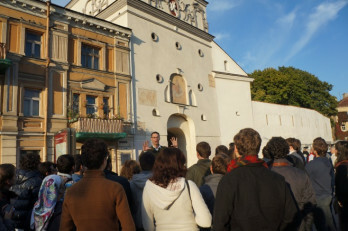
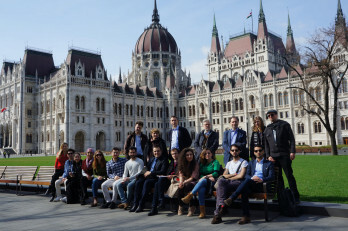
The many extracurricular activities to which the Chair contributes enable students to apply their acquired knowledge and practise their historical skills through visits to museums and places of memory, and debates involving students and visiting speakers on challenging questions of political, social, and cultural co-existence in a plural world. These cultivate the art of critical, unprejudiced engagement with opposing ideas and convictions while respecting the persons who hold them. Polemics should always be ad rem, never ad personam.
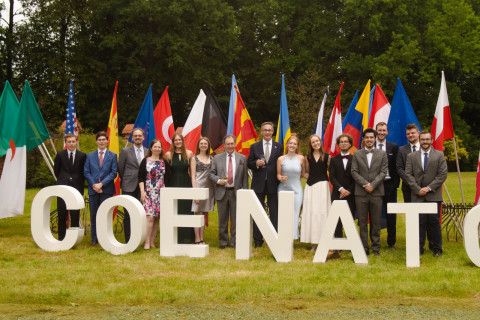
Each year, the Chair presents an award for the best Master's theses on European History and Civilization, written by students at the College of Europe in Natolin. Here are the students who have received the award to date:
- Academic Year 2014-2015:
- Mr Przemysław PAZIK, Radicalism, Revolution and Romanticism: The Ideological Response of Polish Catholic Intellectuals to Communist Rule in Poland 1945–1948
- Academic Year 2015-2016:
- Mr Benjamin CROME, Towards a New Canaan? European Identity in the Light of the Zionist Right, 1929-1931
- Academic Year 2016-2017:
- Mr Radosław SZYMAŃSKI, Rousseau’s Unitary Federal State in the Eyes of Michał Wielhorski
- Academic Year 2017-2018:
- Ms Laura WHETHERLY, 'It’s Their Bloody Country': Opportunities and Obstacles for Cooperation between SOE and Insurgent Armies in Yugoslavia and Greece, 1941-1945
- Academic Year 2018-2019 (ex-aequo):
- Mr Thomas BARKER, Development through Social Movements: To what Extent did Ukraine’s Euromaidan Succeed, where the Orange Revolution Failed?
- Ms Louise VALLEDOR, Les insurrections de l’été 1944 : Paris et Varsovie, une perspective sociohistorique
- Academic Year 2019-2020:
- Mr Grzegorz SZYMBORSKI, The Duchy of Courland and Semigallia between the Polish-Lithuanian Commonwealth and the Russian Empire. Legal Aspects of Charles Christian Wettin’s Reign and the Succession to the Throne in Courland in the Eighteenth Century
- Academic Year 2020-2021 (ex-aequo):
- Mr Joshua Giovanni HONEYCUTT, Sustainability and the History of Liberal Thought
- Ms Émeline Myriam Marie-Guillaume OGEREAU, La représentation de Solidarność en Allemagne. De l’émergence du mouvement aux commémorations de la fin des régimes communistes en Europe
- Mr Wicke Joseph VAN DEN BROEK, Impossible Reconciliation? Memory, ideology and diplomacy in Polish – Russian relations
- Academic Year 2021-2022 (ex-aequo):
- Mr Lorenzo CORNETTONE, The Trial of the prophet: the problematic relationship between Hegel and Nazism
- Ms Jade IAFRATE, Les relations entre la Société Civile Polonaise et les institutions européennes face à la tentative d'une harmonisation du cadre légal de l'avortement à l'échelle de l'Union
- Academic Year 2022-2023:
- Mr Zoltán ILLÉS, Economic Policy Debate in Kadar’s Hungary
- Academic Year 2023-2024 (ex-aequo):
- Ms Maeve CAROLAN, Irish Becomes “A Truly European Language”: How Ireland’s first language waited almost half a century for EU recognition
- Ms Flora KOTLINSKI, Europe sociale et fracture de l’identité européenne, la question du travail détaché dans les relations franco-polonaises. Le cas du Plombier Polonais
- Academic Year 2024-2025:
- Ms Lotte CLAERHOUT, Mapping Memory: Colonial Street Names and Public Memory in Belgium