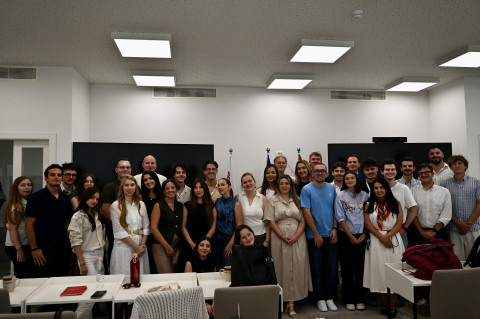
The European Civilization Chair is a center of active research at the College of Europe in Natolin. Its four resident professors—Chairholder Richard BUTTERWICK-PAWLIKOWSKI, Georges MINK, Marek Aleksander CICHOCKI, and Slawomir DĘBSKI - are each widely recognized authorities in their fields. Collectively, their work spans the political, intellectual, social, and cultural history of Central and Eastern Europe from the early modern period to the present and brings particular attention to the enduring legacies of empire, revolution, strategy, and memory in the European experience.
In addition to their individual research and publications, the professors lead and participate in collaborative projects that bring together scholars, students, and partner institutions across Europe. These initiatives stem from the Chair’s commitment to historically grounded inquiry into the ideas and events that have shaped—and continue to shape—European realities in the world.
Current Project
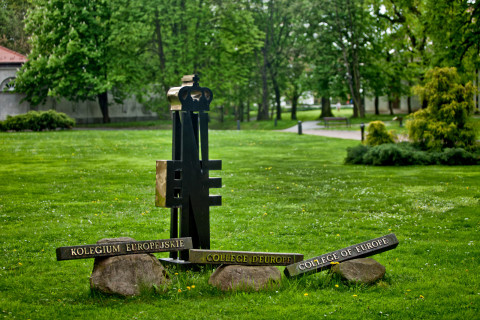
The College of Europe in Natolin: the first decade, 1994-2004
The project examines the history of the establishment of the College of Europe in Poland and its transformation from a filial institution in post-Communist Europe into a vibrant centre of European studies in an EU Member State. This research is conducted along two axes:
- The College of Europe in Natolin: community, institution, and governance – explores the status of the College of Europe in Poland, how the Natolin campus was governed, and in particular, the relationships between the Polish state, the academic community, and Natolin.
- Natolin and the Polish path to EU membership – focuses on the involvement of the high-level decision makers in the process of establishing the College of Europe in Natolin. This research aims to identify the intellectual and political reasons for the decision to establish the Natolin campus.
Recent Projects
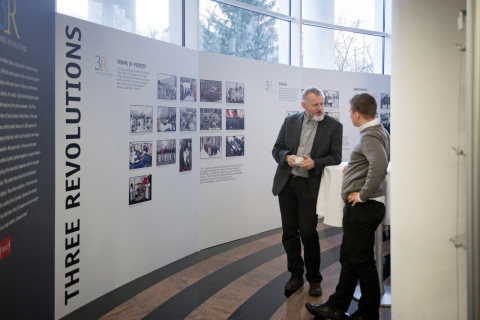
Three Ukrainian Revolutions (3R)
Led by Professors Georges MINK and Paweł KOWAL, the 3R Project offers a multidimensional analysis of Ukraine’s three major protest movements—the Revolution on Granite (1990), the Orange Revolution (2004–2005), and the Revolution of Dignity (2013–2014). Combining oral history, archival research, and comparative political analysis, the project explores the relationship between public mobilization and national transformation in modern Ukraine.
Since 2022, it has taken on new significance on account of the Russian Federation’s full-scale invasion, raising critical questions about the role of historical memory in war and resistance. The project has produced four published volumes of research analyses, interviews, and resources; organized a series of international conferences; and created a publicly accessible oral history archive.
Learn more about the 3R Project here: www.3rnatolin.eu
The Cold War and Its Legacy
This project, led by Professor Marek Aleksander CICHOCKI, examines the political, ideological, and strategic legacies of the Cold War in Europe particularly from the perspective of Central and Eastern Europe. Through a series of high-level debates, workshops, and lectures involving students, guest speakers, and faculty, the project encourages reflection on the Cold War’s continuing influence in contemporary geopolitical and intellectual life.
Past Projects
The Fate of Freedom
This thematic initiative explored enduring tensions between autocracy, oligarchy, and democracy in Eastern Europe. It began with a major interdisciplinary conference in 2016 and continued with the 2018 symposium “Rousseau, Poland and Europe: Federalism – Sovereignty – Prosperity – Patriotism.” These events engaged questions central to Professor Butterwick-Pawlikowski’s research on Enlightenment political thought, constitutionalism, and the Polish-Lithuanian Commonwealth.
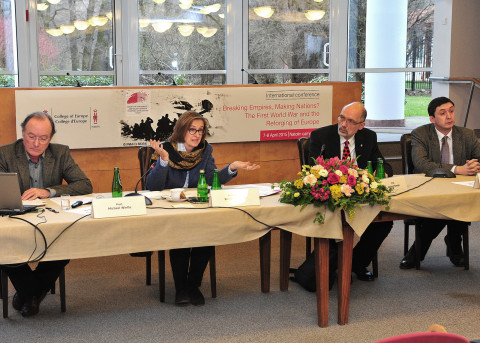
Breaking Empires, Making Nations?
This project addressed the political, social, and cultural aftermath of the First World War with a focus on the dissolution of empires and the formation of new nation-states in Central and Eastern Europe. It culminated in an international conference in 2015 and a published volume of essays as well as a lecture series marking the centenary of the war’s end and its continuing historical impacts.
How to Get Involved in Research
Students at Natolin are warmly encouraged to join in the research life of the European Civilization Chair. Whether by attending project events, participating in workshops, assisting with archival or oral history work, or developing thesis topics related to Chair expertise, there are many ways to take part. Faculty members regularly supervise research in their areas of expertise, and students interested in contributing to ongoing projects are welcome to reach out. Exploring history through active research offers deeper academic insight while also creating opportunities to join a wider conversation about the ideas, conflicts, and transformations that continue to shape Europe today.