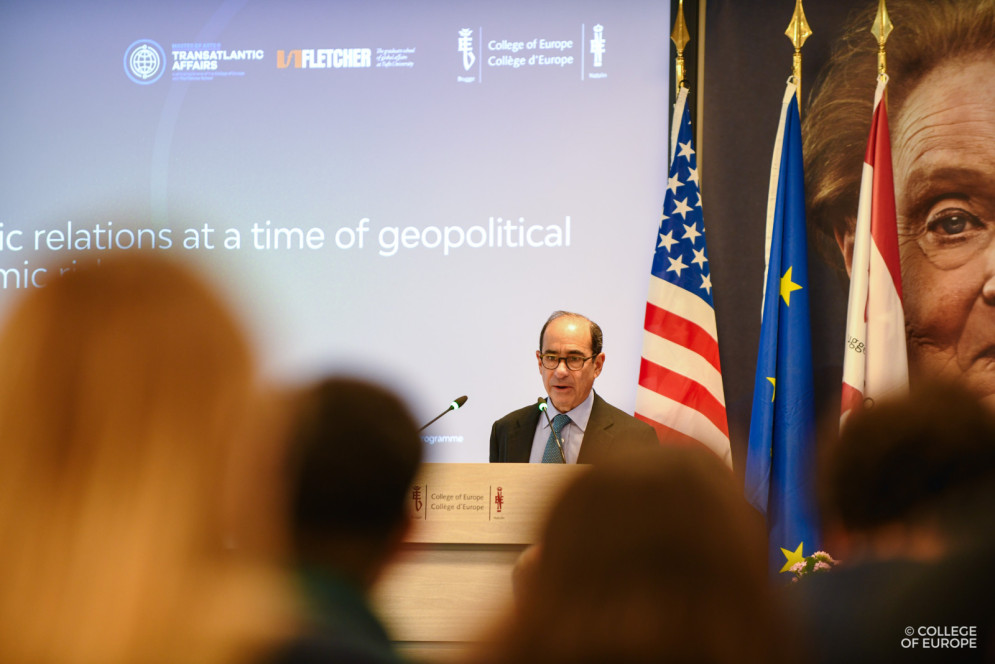
“Understanding transatlantic dynamics has never been more important. Although relations between the United States and Europe have come under considerable strain, recent developments have also demonstrated their enduring importance to our shared prosperity and security. The transatlantic relationship extends beyond governments and institutions. It connects societies and individuals on both sides of the Atlantic.
Making sense of this evolving relationship demands an understanding of fast-moving political and geopolitical developments, as well as the transformations taking place in finance and technology.
Through its contribution to the MATA programme and to policy debates in Europe and the United States, the Chair advances the College’s commitment to preparing a new generation of experts to understand and shape the transatlantic relationship.”
Dr. Ian Lesser was appointed in 2023. Based in Brussels, Ian Lesser is Distinguished Fellow and Advisor to the President at the German Marshall Fund of the United States (GMF).
His expertise includes U.S. foreign and security policy, transatlantic relations, and Mediterranean and Middle Eastern affairs. Before joining GMF, he held roles at the Woodrow Wilson International Center for Scholars, the Pacific Council on International Policy and the RAND Corporation. From 1994-1995, Lesser was a member of the US Secretary of State’s policy planning staff, covering Turkey, Southern Europe, North Africa and the Middle East peace process.
He studied at the University of Pennsylvania, the London School of Economics, and the Fletcher School of Law and Diplomacy, and received his D.Phil from the University of Oxford.
Understanding the Economic Foundations of the Transatlantic Relationship
The transatlantic economy remains the world's largest and most deeply integrated economic partnership. Trade, investment, technology, industrial policy, economic security and regulatory cooperation shape relations between Europe and North America and influence the wider international system.
The Chair of Transatlantic Trade and Economy serves as a focal point for research, teaching and public discussion on these issues. Through academic research, policy dialogue and engagement with practitioners, the Chair contributes to a deeper understanding of the economic dimensions of transatlantic affairs.
Connecting Research, Policy and Practice
The Chair examines the major economic challenges affecting transatlantic relations, including:
- International trade and trade policy
- Economic security and strategic competition
- Industrial and technology policy
- Digital economy and regulation
- Investment and supply chains
- Energy and climate-related economic cooperation
- Global economic governance
The Chair's activities bring together scholars, policymakers, diplomats, business leaders and students to explore how economic interests shape transatlantic cooperation and competition.
Supporting the MATA Learning Experience
Students in the Master of Arts in Transatlantic Affairs (MATA) engage directly with questions of trade, economic policy and transatlantic governance through coursework, practitioner discussions, conferences and research activities. The programme combines European and American perspectives and encourages students to connect academic analysis with contemporary policy debates.
The Chair contributes to this learning environment by:
- Supporting teaching on trade and economic policy
- Connecting students with practitioners and experts
- Promoting policy-relevant research
- Facilitating discussion of emerging economic challenges
- Encouraging interdisciplinary analysis across economics, politics and international relations
Practitioner Expertise
A distinctive feature of MATA is the involvement of practitioners with direct experience in transatlantic policymaking.
Guest speakers include Brian Glynn (former Managing Director for the Americas within the European External Action Service), Rear Admiral de Noronha Bragança (Coordinator of the Atlantic Centre), Elena Lazarou (then-Senior Policy Analyst at the European Parliamentary Research Service and currently Director General of ELIAMEP), Prof. Paul Isbell (Affiliate Professor at Mohammed VI Polytechnic University) and Chris Ogunmodede (Visiting Fellow, German Marshall Fund of the United States).
Events and Public Engagement

The Chair contributes to conferences, practitioner dialogues and public discussions that connect students with contemporary policy debates. Recent events include:
Panel Discussion: Resetting Transatlantic Relations One Year After the US Elections (17 November 2025)
Brussels Roundtable - "The Day After in America" (14 November 2024)
Panel event - The Transatlantic Partnership in an election year. Structural and Situational Challenges (17 September 2024)
Panel event - Transatlantic Relations in a Year of Decision (17 June 2024)
Roundtable - Transatlantic Cooperation on Trade and Technology in a Time of Risk: What Now, What Next? (15 May 2024)
Opening lecture of the Mata Chair (10 November 2023)
Publications:
Ian Lesser, Chair:
- "The Renaissance of Economic Warfare" Policy Center for the New South (2026) [Read the publication →]
- "Far From Disengagement: The U.S. and the Mediterranean Today" Policy Center for the New South (2025) [Read the publication →]
- “The Day After in America” - A summary of remarks by Dr. Ian O. Lesser, Chair in Transatlantic Trade and Economy, prepared by Marie Ketterlin, Research Assistant (2024) [Read the publication →]
Marie Ketterlin, Research Assistant:
- "The EU's Middle East policy and the transatlantic cooperation limbo." In European Council Experts' Debrief (Issue XV, pp. 7–9). Trans European Policy Studies Association. (2025) [Read the publication →]
'Navigating the Atlantic' - The Chair of Transatlantic Trade and Economy's podcast
For more detailed information you can contact Marie KETTERLIN.
Would you like to stay updated on our upcoming events? You can subscribe to our mailing list to receive our invitations!
Subscribe here