What does a programme intend? – clarity of mission, vision, and learning outcomes.
Quality Assurance Policy of the College of Europe
Last updated: 16 June 2026
Overview
The College of Europe is committed to providing advanced Master’s programmes of the highest academic quality. Our quality assurance (QA) policy ensures that all academic activities across our campuses (Bruges, Natolin and Tirana) are continuously reviewed, improved, and aligned with international best practices.
This QA framework is designed in line with the Standards and Guidelines for Quality Assurance in the European Higher Education Area (ESG 2015) and with the requirements of the Flemish Qualifications Framework (FQF, level 7) in which all College of Europe postgraduate programmes (“Master-na-Master”) are officially accredited.
The most recent external educational assessment reports for all academic programmes are listed at the bottom of this page.
The College’s QA policy is guided by a “Plan–Do–Check–Act” (PDCA) logic, addressing four overarching questions:
How does a programme realise its intentions? – curriculum design, faculty and expertise, teaching methods, learning environment, and student support.
How is the achievement of these intentions demonstrated? – student assessment, Master’s thesis, graduate employability/alumni careers.
How is the College investing in continuous quality enhancement? – systematic reflection, reactive and proactive improvement actions, feedback loops.
In line with the Flemish and European standards, the College of Europe seeks to guarantee that:
- Learning outcomes are transparent, relevant and benchmarked;
- Curricula are up-to-date, academically rigorous, in line with state of the art in the respective academic disciplines and the field of European studies and responsive to societal and professional needs;
- The teaching and learning environment supports student achievement;
- Students benefit from accessible services, facilities, and personalised guidance;
- Student assessment is valid, reliable, and transparent;
- Information about programmes, ECTS cards and course outlines is made accessible in a comprehensive manner;
- Stakeholders (students, alumni, external experts) are systematically involved in the continuous quality enhancement.
Quality assurance is embedded at all levels:
- Academic Council: The College’s highest academic decision-making body has to approve all adjustments of programme structures, curricula, learning outcomes, and faculty appointments;
- Campuses: The campus administrations in Bruges, Natolin and Tirana make constant efforts to improve the students’ learning environment, spanning from library access, student counselling to the logistics of board and lodging;
- Departments: The Directors of Studies, supported by their departmental teams, ensure coherence, quality and structured feedback loops within each programme; the continuous involvement of the Department’s visiting professors, a mix of academics and practitioners, provides expertise and insights from stakeholders who are predominantly based in relevant external contexts and thus well placed to also act as peers;
- Student Involvement: Continuous input from students within the above-mentioned structured feedback loops (e.g. course surveys, post-exam surveys, consultations with the departmental team) represents an essential component of the College’s QA; furthermore, a student representative of each programme sits on the Academic Council;
- Alumni Involvement: The close connection that the College maintains with its alumni serves as an additional source of feedback and reflection on the College’s programme from the graduates’ (professional) perspectives; the President of the Alumni Association sits on the Academic Council;
- External Perspectives: Beyond the involvement of visiting professors and alumni, the Departments are embedded in comprehensive networks of academic and professional stakeholders that contribute to continuous reflections and exchange of best practices.
The College’s QA system is future-oriented and designed to evolve. Mechanisms for QA include:
- Annual review of curricula and faculty in view of recent academic or policy developments; responding to students’ feedback and demands;
- Systematic student course evaluations and programme-wide surveys;
- Stakeholder consultations with students, alumni, professional field representatives, and external experts;
- Implementation of accreditation feedback: the College of Europe systematically follows up on and implements the recommendations of external review panels;
- Transparency: QA policies and information on the content and quality of the programmes are publicly accessible (e.g. via the ECTS cards of all courses); additional information and resources for students are available via the intranet/learning platform.
External Educational Assessment Reports:
- Programme Review: Master of Science in European Economic Studies - Master of Arts in European Interdisciplinary Studies - Master of Arts in EU International Relations and Diplomacy Studies - Master of European Law - Master of Arts in European Political and Governance Studies, College of Europe (Bruges/Natolin), VLUHR 2026, available here;
- Master of Arts in European Transformation and Integration – The EU and Southeastern Europe, College of Europe – Initial Accreditation, Assessment Report, NVAO 2024, available here;
- Programme Review: Master of Arts in Transatlantic Affairs, College of Europe and The Fletcher School of Law and Diplomacy at Tufts University, VLUHR 2021, available here.
General News
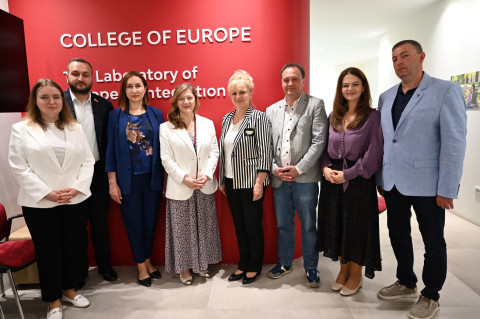
Research Service of the Ukrainian Parliamentary visited our campus
As part of their study visit to Albania, researchers from the today and met with our resident professor, Odeta Barbullushi. Their discussion focused on European integration, capacity-building of the...